What Counts as Square Footage? A Marin County Guide to Verifying Home Size
April 23, 2026
April 23, 2026
When buying or selling a home in Marin County, one of the most commonly cited — and most misunderstood — data points is square footage. It plays a major role in pricing, value perception, and buyer decision-making, yet it’s rarely as precise as people assume.
The reality: there is no single universally “correct” square footage number for most homes.
Let’s break down what actually counts, where these numbers come from, and what buyers should pay attention to.
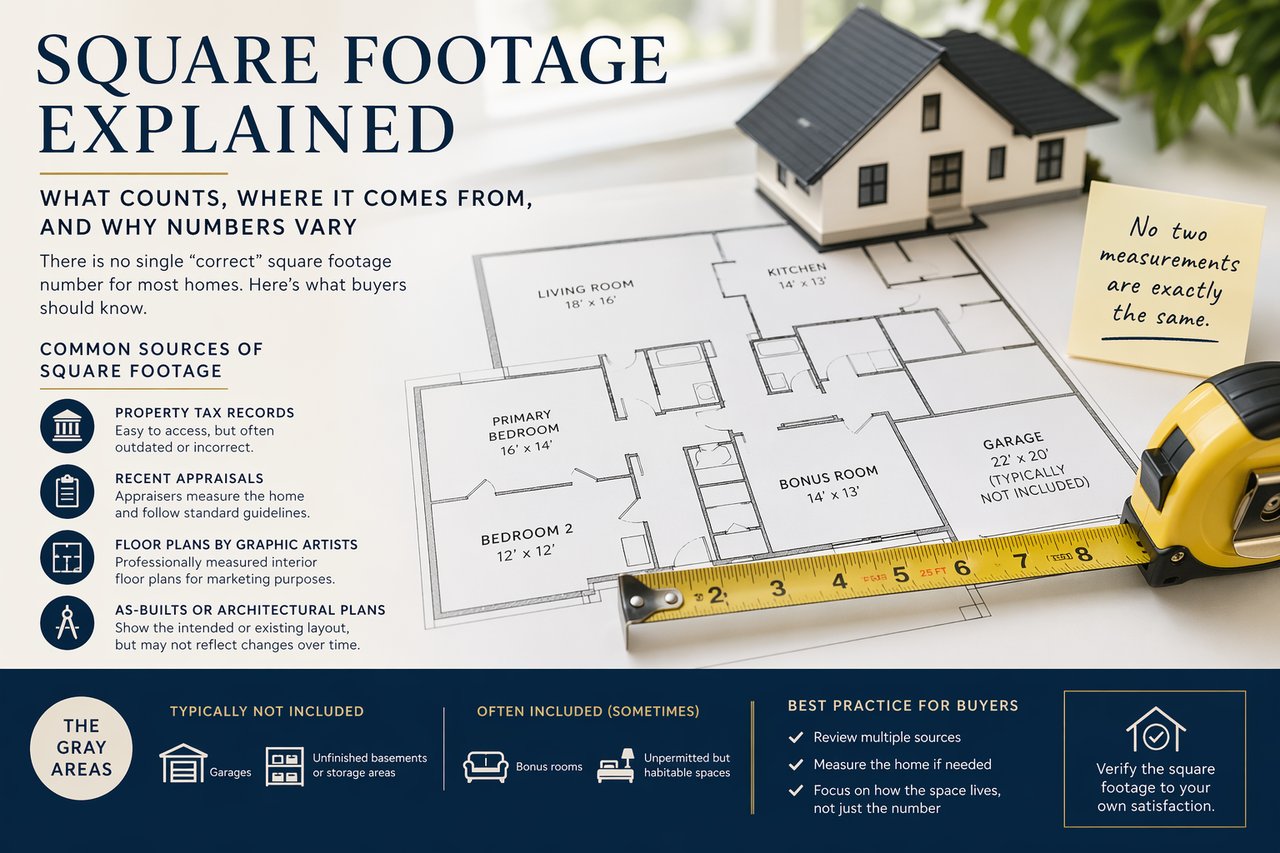
In nearly every listing, square footage is pulled from one (or more) of the following sources:
This is often the default number used in listings. However, tax records can be outdated or inaccurate — especially if improvements, additions, or remodels were done without updates being reported.
Key takeaway:
Tax records are easy to access, but not always reliable.
Licensed appraisers typically measure the home themselves as part of the appraisal process. They often follow standardized guidelines when calculating square footage.
Why this matters:
Appraisals are generally one of the more credible sources — but even they can vary slightly depending on methodology.
Many listings today include professionally measured floor plans created by third-party companies. These are typically based on interior measurements and are used for marketing purposes.
Important note:
These measurements are helpful for visualizing layout and flow, but they are still considered approximate.
Original plans or updated “as-built” drawings can show the intended or existing layout of the home.
The catch:
Plans don’t always reflect what was actually constructed — or what exists today after years of changes.
Here’s the part that surprises most buyers and sellers:
👉 It’s completely normal for square footage numbers to differ — sometimes meaningfully — across sources.
Why?
Even highly qualified professionals can come up with slightly different numbers for the same property.
Not all space is treated equally — and this is where things can get a bit subjective.
In many cases, if a space is habitable and functional, it may be included in the marketed square footage — even if it doesn’t strictly meet permitting standards.
This creates a gray area that varies from listing to listing.
Given all of this variability, there’s one clear best practice:
👉 Buyers should independently verify square footage to their own satisfaction.
That might include:
Square footage is an important metric — but it’s not an exact science.
At the end of the day, how a home feels, functions, and fits your needs is just as important — if not more — than the exact square footage figure.
In Marin County real estate, the most informed buyers understand this nuance. They don’t rely on a single number — they look at the full picture.
If you ever have questions about how square footage is being represented in a specific property, it’s worth digging deeper. That extra diligence can make a meaningful difference in how you evaluate value.
Stay up to date on the latest real estate trends.

Alexander Narodny | September 2, 2026

Alexander Narodny | August 18, 2026

Alexander Narodny | August 6, 2026

Alexander Narodny | July 21, 2026

June 26, 2026

Alexander Narodny | June 25, 2026

Alexander Narodny | June 18, 2026

Alexander Narodny | June 11, 2026
Alexander Narodny | June 5, 2026
You’ve got questions and we can’t wait to answer them.