Benefits of Having a Well on your Property in Marin County
August 18, 2026
August 18, 2026
When buyers think about the features that add value to a Marin County home, they usually focus on the obvious things: a great kitchen, a flat yard, views, privacy, or proximity to trails and town. One feature that often flies under the radar is having a private well on the property.
In certain parts of Marin, wells are more common than many buyers realize. And depending on the property and the productivity of the well, having your own water source can be a significant benefit—particularly for homes with large yards, extensive landscaping, gardens, pools, or acreage.
Perhaps the most obvious benefit is the potential savings on your water bill. A property with a productive well may be able to use well water for landscaping and irrigation rather than purchasing all of that water from the local water district.
For a small yard, that may not make a huge difference. But on a half-acre, one-acre, or larger property with extensive landscaping, the savings can add up quickly.
There are still costs associated with owning a well—including electricity to operate the pump, maintenance, testing, treatment when necessary, and eventual equipment replacement—but you're not paying a water district for every gallon that comes out of the ground.
This is where wells can really shine in Marin.
Large lawns, vegetable gardens, fruit trees, vineyards, landscaping and other water-intensive improvements can be expensive to maintain using municipal water alone.
A productive irrigation well can give a homeowner considerably more flexibility. That's particularly valuable on some of Marin's larger properties, where maintaining the grounds is a meaningful part of homeownership.
A private well gives you an additional water source that isn't entirely dependent on the public distribution system.
This doesn't necessarily mean unlimited water. Well production can fluctuate, particularly during extended dry periods, and groundwater use can still be subject to regulations. But having another source of water can provide an added degree of independence.
It's worth noting that Marin County regulates private wells and requires permits for drilling. Wells intended to supply domestic drinking water have additional requirements, including water-quality testing.
One of my favorite configurations is a property that has both municipal water and a private well.
The house can remain connected to the public water system for normal household use, while the well can potentially be used for irrigation and landscaping.
You get the reliability and convenience of municipal water without necessarily having to use expensive treated water to keep an expansive Marin yard green.
Not every buyer will specifically search for a house with a well, but on the right property it can absolutely be a selling feature.
Imagine two comparable homes with large landscaped lots. One requires thousands of gallons of municipal water during the summer, while the other has a productive irrigation well.
That's a feature worth pointing out.
Of course, the details matter. Buyers should understand the well's production, condition, water quality, pump and equipment before assigning significant value to it.
Marin isn't one-size-fits-all when it comes to water. Many of our more densely developed communities rely almost exclusively on municipal water, while private wells become more common as you move toward larger parcels and Marin's rural areas.
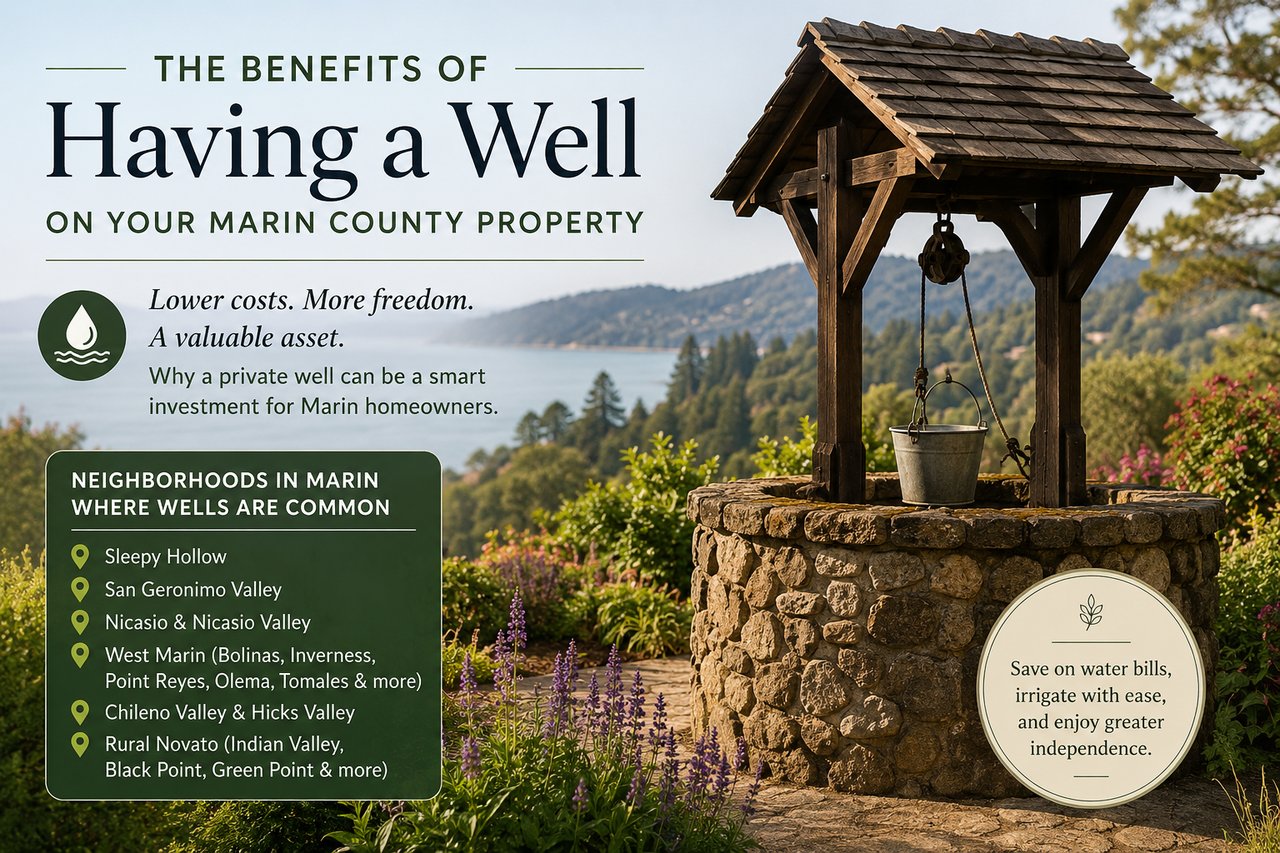
Some of the areas where you may encounter private wells include:
Sleepy Hollow — While most Sleepy Hollow properties are served by public water and wells should not be considered typical throughout the neighborhood, you do occasionally encounter properties with private wells—particularly on larger parcels. For those homeowners, a well can be especially useful given Sleepy Hollow's larger lots, pools, lawns, gardens and extensive landscaping. County planning documents confirm that Sleepy Hollow has existing water infrastructure, so a well here is more appropriately viewed as a potentially valuable supplemental feature rather than the neighborhood's normal water source.
San Geronimo Valley — Wells are more established here. County environmental analysis identified dozens of parcels with groundwater wells believed to be active for domestic and/or irrigation purposes, particularly in the lower portion of the valley.
Nicasio and Nicasio Valley — With its rural character, ranches and larger acreage properties, Nicasio is one of the places in Marin where encountering a private water source isn't particularly surprising.
Chileno Valley and Hicks Valley — These rural areas of West Marin feature larger parcels, farms and ranch properties where private water infrastructure may be encountered.
West Marin — Depending on the specific property, wells and private water systems may be found around communities such as Olema, Inverness, Point Reyes, Tomales, Bolinas, Forest Knolls, Lagunitas and Woodacre, as well as on rural properties outside the village centers. Marin County itself groups many of these communities with Nicasio, Chileno Valley, Hicks Valley, Marshall, Stinson Beach and Muir Beach as part of rural West Marin.
Rural Novato — Larger properties in areas such as Indian Valley, Black Point, Green Point and western Novato may also have wells or other private water infrastructure.
The important takeaway is that well prevalence can vary dramatically from one property to the next—even within the same neighborhood. Never assume that a property has a well simply because the house next door does.
Simply seeing "private well" on a property disclosure doesn't automatically mean you've struck water-supply gold.
When evaluating a property with a well, I want to know:
Marin County notes that a well intended for domestic drinking water must produce sufficient water and meet applicable water-quality requirements.
A good well isn't just an interesting feature buried somewhere in the disclosures. On the right Marin property, it can be a genuine asset.
For homes with extensive landscaping, acreage, gardens, pools or other substantial outdoor water needs, a productive well can reduce water costs and provide an additional source of water.
And in neighborhoods like Sleepy Hollow, where municipal water is the norm but some properties may have supplemental wells, finding a home with both public water and a productive private well can be an especially attractive combination.
As with so many things in Marin real estate, however, the value is in the details. If you're buying a property with a well, don't just confirm that the well exists. Find out what it produces, what it can legally be used for, and how reliably it has performed.
Stay up to date on the latest real estate trends.

Alexander Narodny | September 23, 2026

Alexander Narodny | September 2, 2026
Alexander Narodny | August 18, 2026

Alexander Narodny | August 6, 2026

Alexander Narodny | July 21, 2026

June 26, 2026

Alexander Narodny | June 25, 2026

Alexander Narodny | June 18, 2026

Alexander Narodny | June 11, 2026
You’ve got questions and we can’t wait to answer them.